A Monthly Money Check-In That Fits on One Page
A monthly money check-in can help you spot upcoming costs, review spending against your intentions and choose one clear question to carry into next month.
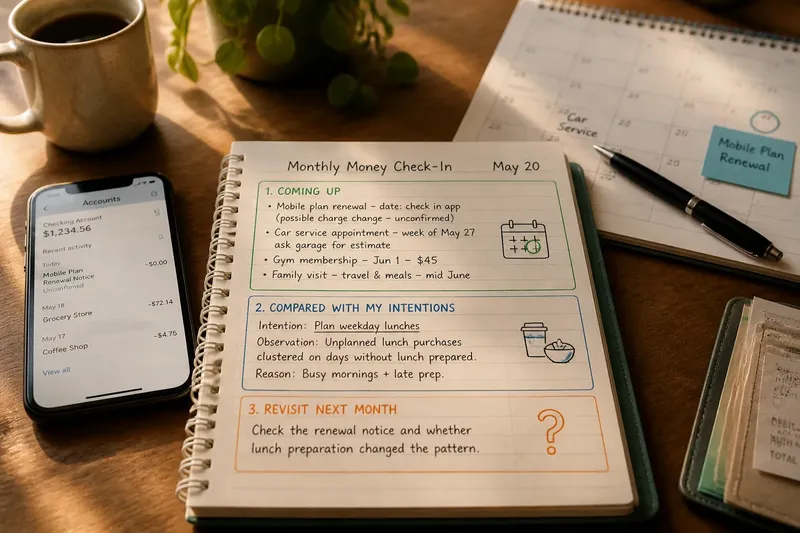
A monthly money check-in is easier to use when it helps you decide what needs attention next. A notebook page, a bank app and your calendar can be enough to spot upcoming costs, compare one spending pattern with your intentions and choose a useful follow-up.
Keep the review separate from bookkeeping. You do not need to reconstruct every transaction or explain every choice. Note estimates as estimates, and stop once you have a clear next action or a reason to wait for more information.
Give the page three jobs
Write the month and the date of your review at the top. Then divide the page into three sections: “Coming up”, “Compared with my intentions” and “Revisit next month”. Keep each note brief enough to read at a glance.
- Coming up: list bills, irregular costs and changes to income or commitments. If a date or amount is uncertain, mark what needs checking instead of guessing.
- Compared with my intentions: note one spending pattern and the intention you had in mind. If you had no specific intention, record something that surprised you and the circumstances around it.
- Revisit next month: write one question, decision or observable action. If nothing needs changing yet, make the follow-up a check for missing information.
Use records that are already easy to reach, such as a bank app, calendar, bill folder or notes app. If sensitive information might be visible to others, leave account numbers and login details off the page.
Check upcoming costs without guessing
Regular bills are often easy to remember; renewals and occasional commitments can be less visible. Scan the next month in your calendar and check bill reminders or account notices you already receive. Note the cost and its likely due date when known. If the amount is unclear, write “check amount” and record where you can confirm it.
Include changes that may affect ordinary spending, such as a different work pattern, a planned visit or a family commitment. The aim is to make the month easier to anticipate, not to predict every purchase.
Say you see a car service appointment in your calendar, but the garage has not confirmed the charge. You note the appointment week, add “ask garage for estimate”, then check the garage’s reply before deciding how to account for the cost. The resulting decision is based on a confirmed estimate rather than a made-up figure.
Compare one spending pattern with your intention
A total can conceal very different circumstances. A one-off event, a change in routine and repeated convenience purchases may call for different responses, even if they affect the same spending category.
Choose one area and compare it with a specific intention. “I wanted to plan weekday lunches” gives you something to examine; “I should spend less” does not explain what to look for. Check only the relevant transactions or category total if they are readily available, then ask what made the choice easier or harder.
Use neutral language. A difference from your intention is information, not a judgement of character. If an unusual expense was planned, record that context. If a routine made a choice difficult, consider changing the routine rather than writing a vague promise to be more disciplined.
Classifying every small purchase is not worth the effort if it leaves no time for a decision. Look at detail only until you understand the pattern you want to revisit.
Use observations to choose what happens next
For each note, decide what the observation means for your next action. These checks keep the page useful without turning it into a long task.
- Upcoming bill: check whether the date and amount are confirmed. If both are clear, note them; if either is uncertain, record where and when you will verify it.
- Unfamiliar transaction: check the relevant bank or card record. If you recognise it, leave it off the follow-up list; if not, contact the provider through its official channel.
- Spending differs from an intention: check whether the difference came from a one-off event or a repeated routine. If it was unusual, record the context; if it may recur, choose one routine or decision to revisit.
- Several possible changes: check which one affects an upcoming commitment or answers a useful question. If one stands out, carry it forward; if none is clear, wait for more information rather than making several promises.
- Missing records: check whether the missing detail would change a decision. If it would, note the account or document to consult; if it would not, leave the uncertainty marked and move on.
- No clear intention to compare: check for a pattern that surprised you and note its circumstances. If it suggests a question, carry that question forward; if not, choose a modest intention that you can recognise next month.
Imagine your starting notes are a calendar entry for a mobile plan renewal, a bank-app notice with no confirmed new charge, and an intention to plan weekday lunches. You first write “renewal date: check in account app” under “Coming up”. Next, you mark the possible charge as unconfirmed and decide to read the notice before treating it as a bill. Then you review only the lunch-related spending you can readily identify and note whether unplanned purchases clustered on days without lunch prepared. Your final prompt is: “Check the renewal notice and whether lunch preparation changed the pattern.” The trade-off is clear: you have a useful next review, but you have not tried to reconcile every account or claim that a change has already worked.
Keep the review from becoming a record hunt
A one-page check-in becomes burdensome when it is expected to serve as a bookkeeping system. Start with records at hand and note only details that affect a decision. If an entry is unfamiliar, mark it for a separate check instead of letting it consume the review.
Detailed records may be needed for tax, reimbursement or household administration. Those tasks have separate requirements, so use an appropriate record-keeping method and follow the relevant rules rather than relying on this brief review.
What should a monthly money check-in answer?
How much detail belongs on the page?
Include enough detail to identify an upcoming cost, a spending pattern or a question to revisit. A short description and a date can be more useful than copying a full transaction list.
Should I check every account and purchase?
Only check detail that could change a decision. Start with records you normally use, and note anything that needs a separate check rather than turning the review into a reconciliation.
What if I have no spending intention to compare?
Record a pattern that surprised you and the circumstances around it. You can choose a simple intention for next month, such as planning weekday lunches or checking a recurring charge.
What if I miss a month?
Resume with the current month instead of reconstructing every missed page. Look ahead at upcoming costs, review one recent pattern and choose a single item to revisit.
Leave a useful prompt for next month
Before putting the page away, write the question you want to answer, the event or date that will help answer it, and where to find the relevant information. For example, note: “Check the mobile plan renewal notice in the account app before the next review.”
A monthly money check-in should leave you with a clearer view of what needs attention, not a list of promises. Keep uncertainty visible and carry forward only a question that still matters. If an urgent bill or serious shortfall needs action, address it separately rather than waiting for the next review; a qualified financial adviser or debt adviser may help with a complex decision or difficulty meeting essential commitments.